
The main layout patterns
| Pattern | Look | Waste | Difficulty |
|---|---|---|---|
| Straight grid | calm, modern | 5–10% | easy |
| ½ offset (running bond) | classic, lively | 10–12% | easy |
| ⅓ offset | calmer, ideal for long tiles | 10–12% | easy |
| Random offset | natural, like wood planks | 10–15% | medium |
| Diagonal 45° | room feels larger | 15–20% | medium |
| Herringbone | elegant, dynamic | 15–20% | advanced |
| Basket weave | decorative | 10–15% | medium |
Offset: half or one third?
In a ½ offset the joint of every second row sits exactly in the middle of the tile below. That works well up to about 60 cm (24 in) length.
For longer tiles a ⅓ offset is recommended: large tiles are slightly bowed from manufacturing. If the middle of one tile meets the edge of the next, you get visible height differences (lippage). Many manufacturers limit the offset to one third – a leveling system helps too.
How to lay tiles diagonally
Diagonal tiles make small rooms feel larger and hide out-of-square walls, because the eye has no parallel lines to compare.
- Find the room's center and mark a 45° axis – easiest with a cross-line laser.
- Work from the center outwards; the edge tiles are cut into triangles last.
- For material, allow 10% base waste plus a 5–10% diagonal surcharge.
- Consider a border of straight-laid tiles if the triangles along the walls look busy.
Herringbone and wood-look tile
Herringbone works with narrow, long tiles – typically 15 × 90 cm (6 × 36 in) or 20 × 120 cm (8 × 48 in) in wood look. Tiles are set at right angles to each other; every edge needs angled cuts. Allow 15–20% waste and plan a center line to align the pattern.
For a plank look, a random offset is the easier alternative: the offcut from one row starts the next, and waste stays moderate.
Try the pattern first
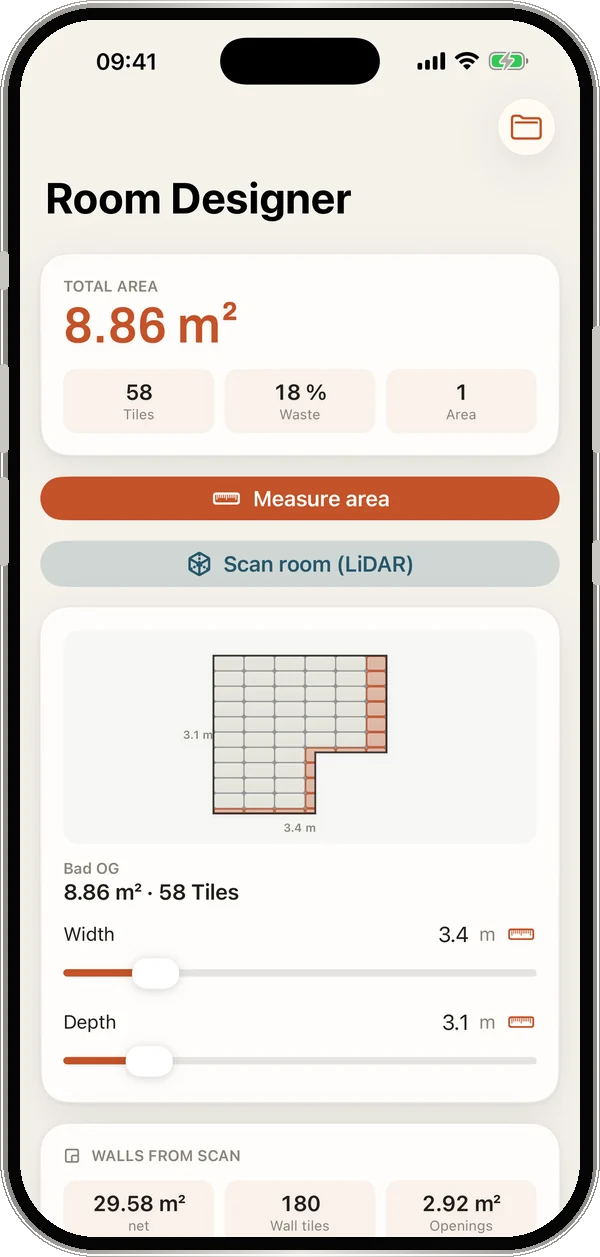
The best way to know whether a pattern works is to see it in your room. The TileWright room designer draws your room to scale – including scanned L-shapes – and shows straight, ½ and ⅓ offset, diagonal and basket weave with real tile looks and grout color. Cut tiles are highlighted, and tile count and waste update instantly.
Which pattern for small rooms?
In small bathrooms and hallways, a few large tiles with narrow joints look calmer than many small ones, and a diagonal layout makes the room feel wider still. Long tiles parallel to the long wall stretch a narrow room; laid crosswise it looks wider.
Be careful with busy patterns in tiny rooms: herringbone on 2 m² (20 sq ft) creates a lot of waste and can feel restless. A ⅓ offset in wood look is often the better choice.
Joint pattern and grout color
A pattern reads mainly through its joints. Grout close to the tile color keeps the surface calm and spacious; contrasting grout emphasises the pattern – intended with subway tile or herringbone, usually not with large format.
In the TileWright room designer you can choose tile and grout color separately and see the result in your room before buying.
Try patterns in your own room
TileWright calculates all of this live as you type – with a LiDAR room scan for real floor plans, doors and windows deducted automatically, a room designer and a PDF material list. Fully offline.
Download on the App StoreFrequently asked questions
Which tile pattern makes a room look bigger?
Diagonal layouts and large tiles with narrow joints. A grout color close to the tile also calms the surface.
How much waste for a diagonal layout?
15–20%, because every edge tile is cut into a triangle.
Why offset long tiles by only one third?
Large tiles are slightly bowed. A half offset creates visible lippage; a ⅓ offset reduces it.
What is a random offset pattern?
Tiles are laid with an irregular offset, usually starting each row with the offcut from the previous one – typical for wood-look tile.
What is the easiest tile pattern?
A straight grid. Offset patterns come next; diagonal and herringbone take more time and skill.