
The formula explained
The formula calculates the joint volume per square meter and multiplies it by the density of the grout. (A + B) ÷ (A × B) is the joint length per area: the smaller the tile, the larger the value.
Joint depth is roughly the tile thickness minus the adhesive bed – about 6–8 mm for wall tiles, 8–10 mm for porcelain. Density is on the data sheet; cement grout is about 1.6 kg/dm³, epoxy slightly higher.
Coverage table by tile size
Guide values at 8 mm joint depth and 1.6 kg/dm³:
| Tile size | 2 mm joint | 3 mm joint | 5 mm joint |
|---|---|---|---|
| 10 × 10 cm (4 × 4 in) | 0.51 kg/m² | 0.77 kg/m² | 1.28 kg/m² |
| 20 × 20 cm (8 × 8 in) | 0.26 kg/m² | 0.38 kg/m² | 0.64 kg/m² |
| 30 × 60 cm (12 × 24 in) | 0.13 kg/m² | 0.19 kg/m² | 0.32 kg/m² |
| 60 × 60 cm (24 × 24 in) | 0.09 kg/m² | 0.13 kg/m² | 0.21 kg/m² |
| 60 × 120 cm (24 × 48 in) | 0.06 kg/m² | 0.10 kg/m² | 0.16 kg/m² |
1 kg/m² ≈ 0.2 lb/sq ft. Mosaic uses many times more: 25 × 25 mm with a 2 mm joint is around 2 kg/m².
Which joint width for which tile?
A grout joint absorbs tile size tolerances and movement and makes cleaning possible. Setting tiles without joints is a bad idea – even with rectified tiles.
| Tile / area | Typical joint |
|---|---|
| Ceramic wall tile | 2–3 mm (1/16–1/8 in) |
| Floor tile up to 60 cm | 3–5 mm (1/8–3/16 in) |
| Rectified tile | 2–3 mm (1/16–1/8 in) |
| Large format 60 × 120 cm and up | at least 3 mm (1/8 in) |
| Natural stone, terracotta, rustic tile | 5–10 mm (3/16–3/8 in) |
| Outdoors | at least 5 mm (3/16 in) |
The tile manufacturer's recommendation takes precedence.
Grouting in practice
- Grout only once the adhesive has cured – usually after 24 hours, sooner with rapid-set adhesive.
- Work the grout in diagonally with a rubber float, then wash off with a damp sponge.
- Mix only what you can use in 30–45 minutes.
- Leave corners and joints at tubs and showers open and close them with flexible silicone.
- Test the grout color on a spare tile – it dries lighter than it looks wet.
Which grout for which area?
| Grout | Use | Notes |
|---|---|---|
| Cement-based, standard | indoor walls, dry areas | inexpensive, easy to use |
| Cement-based, polymer-modified | floors, underfloor heating, bathrooms, outdoors | water-repellent, fewer cracks |
| Epoxy | showers, kitchens, commercial | very dense and stain-resistant, harder to work |
For the calculation only the density changes: epoxy is slightly heavier; the data sheet has the exact figure.
Worked example: mosaic vs. large format
The same 5 m² area, joint 2 mm wide and 6 mm deep, density 1.6:
- Mosaic 25 × 25 mm: (25 + 25) ÷ (25 × 25) × 2 × 6 × 1.6 = 1.54 kg/m² → 7.7 kg
- Large format 60 × 120 cm: (600 + 1200) ÷ (600 × 1200) × 2 × 6 × 1.6 = 0.05 kg/m² → 0.24 kg
Mosaic needs over 30 times as much grout – which is why the formula beats a rule of thumb.
Grout included automatically
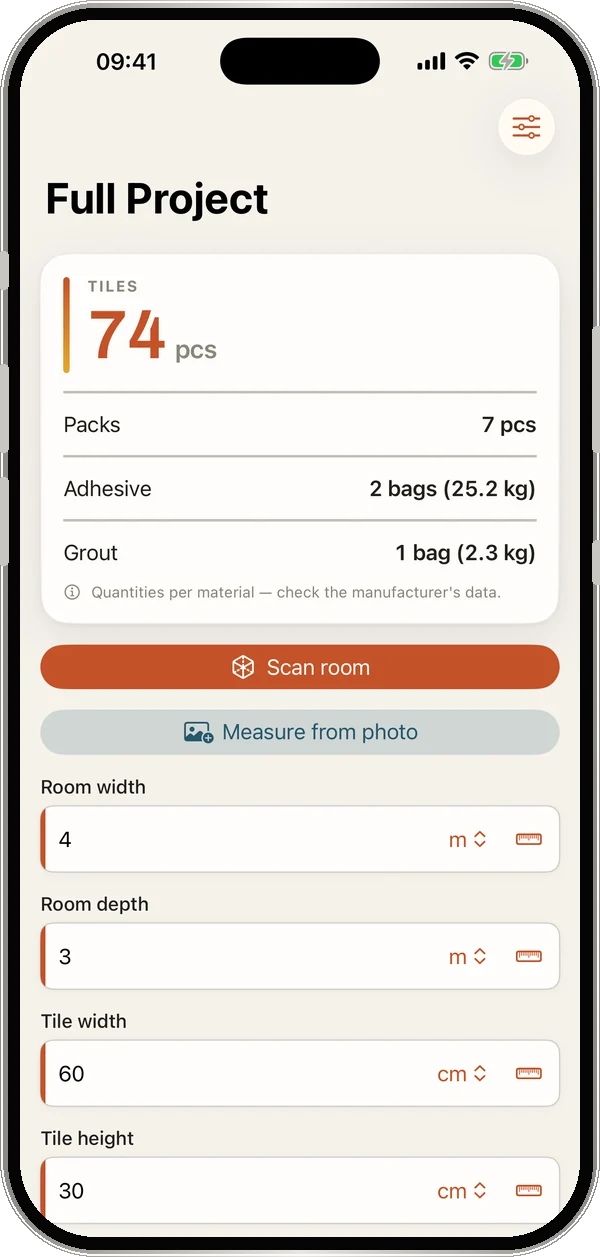
TileWright calculates all of this live as you type – with a LiDAR room scan for real floor plans, doors and windows deducted automatically, a room designer and a PDF material list. Fully offline.
Download on the App StoreFrequently asked questions
How much grout per square meter?
Depending on tile size and joint, 0.1–1.5 kg/m². 30 × 60 cm with a 3 mm joint: about 0.2 kg/m²; small 10 × 10 cm tiles: about 0.8 kg/m².
What grout joint width is standard?
2–3 mm on walls, 3–5 mm on floors, at least 3 mm for large formats and at least 5 mm outdoors.
How deep is a grout joint?
About the tile thickness minus the adhesive bed – usually 6–10 mm. Tile thickness is a good approximation.
Can tile be installed without grout lines?
No. Tiles have size tolerances and move with the substrate. Without joints, chipping and cracks are likely.
How long before grouting new tile?
Usually 24 hours; with rapid-set adhesives a few hours according to the manufacturer.