
Where waste comes from
Waste comes from three places: edges, where tiles are cut to size; breakage while cutting and handling; and the pattern – in an offset layout every other row starts with a partial tile, and in a diagonal layout every edge tile becomes a triangle.
An offcut can often be reused on the opposite edge – but only if it's wide enough, and almost never with diagonal or herringbone patterns.
Waste allowance by layout
| Layout | Waste | Why |
|---|---|---|
| Straight grid | 5–10% | edge cuts only, offcuts reusable |
| ½ offset (running bond) | 10–12% | partial tiles at row starts |
| ⅓ offset | 10–12% | recommended for long formats |
| Random offset | 10–15% | irregular offcuts |
| Diagonal 45° | 15–20% | all edge tiles become triangles |
| Herringbone | 15–20% | angled cuts on every edge |
| Large format (24 × 48 in and up) | 12–15% | few, expensive tiles – every break counts |
Room size and shape matter too
The smaller the room, the larger the share of edge tiles. In a 2 m² (20 sq ft) powder room nearly every tile is cut; in a large living room only a fraction. Rule of thumb: under 5 m² (50 sq ft) add about 5 percentage points.
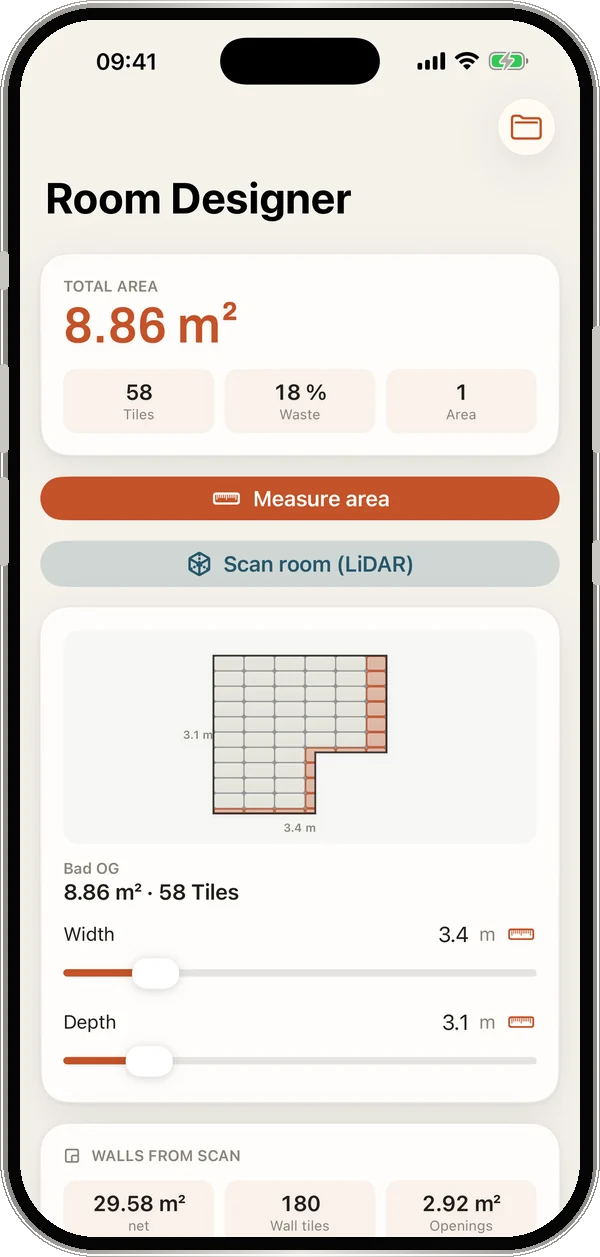
Corners, projections, fireplaces and columns increase waste as well. The TileWright room designer highlights every cut tile and shows the actual waste for your chosen pattern.
Large-format tiles
From 60 × 120 cm (24 × 48 in) up, mistakes get expensive: one tile covers 0.72 m², a 120 × 120 cm tile 1.44 m². A few bad cuts are a large share, and offcuts are often too narrow for the opposite edge. Allow 12–15% and plan the layout so you avoid slivers under 20 cm (8 in).
- Center the layout so both edge strips are equal.
- Limit the offset to ⅓ for long formats to avoid lippage.
- Use the right tools: a cutter long enough for the tile and suction lifters reduce breakage considerably.
Comparison: one room, three patterns
How much the pattern changes demand shows in a 12 m² room with 30 × 60 cm tiles (0.18 m²). Net, 66.7 tiles fit the area:
| Pattern | Waste | Tiles | More than straight |
|---|---|---|---|
| Straight | 8% | 72 | – |
| Offset | 12% | 75 | +3 |
| Diagonal | 18% | 79 | +7 |
Seven extra tiles is about 1.3 m² of material – plus considerably more cutting.
Common waste mistakes
- Using a flat 10% for everything – including diagonal and large format.
- Adding waste to boxes instead of to the tile count.
- Throwing offcuts away before skirting, reveals and niches are done.
- Not planning the layout and ending up with slivers under 5 cm (2 in).
See the waste for your pattern
TileWright calculates all of this live as you type – with a LiDAR room scan for real floor plans, doors and windows deducted automatically, a room designer and a PDF material list. Fully offline.
Download on the App StoreFrequently asked questions
How much extra tile should I buy for waste?
5–10% for a straight layout, 10–12% offset, 15–20% diagonal or herringbone, 12–15% for large formats.
How much waste for 24 × 48 tiles?
12–15%. Large tiles have fewer but more expensive offcuts, and breakage counts more.
How much waste for a diagonal tile layout?
15–20%, because every edge tile is cut into a triangle. See our layout patterns guide.
Is waste added before or after rounding up?
Before: area ÷ tile area × (1 + waste), then round up to whole tiles and boxes.
Do small bathrooms need more waste?
Yes. In small rooms a high share of tiles are cut at the edges – add about 5 percentage points.